
In middle school, we help young people navigate some of the most significant changes they have experienced in their lives. As a middle school principal, that makes me think deeply about change, especially about how the way we lead change shapes the culture around everyone in the building, not only the changes our students are experiencing,
I do not mean culture as a slogan on a wall or something we describe during an admissions tour. I mean the culture students and teachers actually experience every day.
- What happens when a student walks into a classroom?
- How do adults respond when something goes wrong?
- What do we celebrate?
- Who gets a voice?
- What does learning look and sound like?
And perhaps most importantly:
- Do the decisions we make as adults reinforce the culture we say we want?
These questions have shaped much of my work developing what I call The Middle School Lens. What started as an attempt to create a clearer identity for our middle school has gradually become something much deeper: a way of looking at culture, leadership and change more intentionally.
Along the way, I have become increasingly interested in one question:
Are we really changing our schools, or are we simply adding more things to them?
Culture Leaves Clues
If you walked into a school you had never visited before, how long would it take you to begin forming an opinion about what that school values?
Probably not very long.
If you walked into my school, you would notice our shared philosophy all over the walls. You would hear how adults speak to students and bring them into focus. You would watch how students interact with one another. You might notice how we get students to learn cooperatively, how teachers teach the skill of conduct, and what happens when expectations are not met.
Culture leaves clues. This matters because culture exists whether we intentionally design it or not. Every routine, policy, conversation and response communicates something about what matters.
The word that stands out to me is “intentionally.” Good intentions are not the same thing as intentional leadership. And intention is shaped by our habits.
Schools Have Habits Too
In his incontestable book Atomic Habits, James Clear writes:
“One of our greatest challenges in changing habits is maintaining awareness of what we are actually doing.”
That idea really stayed with me. The book is mainly talking about individual habits, but when I read it, I immediately started thinking about schools. Because schools have habits too.
- How do we respond when students misbehave?
- Who normally makes decisions?
- How do we talk about assessment?
- What happens in staff meetings?
- What do leaders look for during classroom visits?
- How do students receive feedback?
Some practices have existed for so long that they become almost invisible. We stop asking why we do them because they have simply become “what we do here.” That can be a strength. Positive routines give schools stability and consistency.
But it can also become a barrier to improvement.
Sometimes the first step in changing culture is simply becoming more aware of the culture we already have.
Not All Change Is Equal
In thinking about change, though, it is critical to understand that not all change is the same. There are actually two types of change: first- and second-order change.
First-order change improves something within an existing way of thinking. We introduce a new form, for example. We adjust a timetable. We train teachers in a strategy. We implement a student survey.
All of these can be worthwhile.
Second-order change goes deeper.
It asks us to challenge assumptions, relationships, roles and structures. Research into second-order change describes it as a significant departure from existing norms and practices, sometimes requiring leaders to rethink both how a problem is defined and how it should be addressed.
Consider behaviour.
Introducing a new behaviour referral form is probably first-order change. Moving from a belief that behaviour is primarily about compliance to a belief that behaviour includes skills that young adolescents need to be explicitly taught is second-order change.
Or consider “student voice.”
Creating a student survey is first-order change. Creating a culture in which students genuinely influence meaningful decisions goes a long way into changing the relationship between adults and young people. That starts to feel like second-order change.
Neither type of change is inherently better. Schools need both.
The important leadership question is whether we are using the right type of change for the problem we are trying to solve.
A Lens for Culture
My own thinking has increasingly settled around four questions. They have also been influenced by my reading of Peter De Witt and Michael Nelson’s Leading With Intention and its emphasis on self-awareness and intentional leadership.
1. Culture and Belonging
What does it feel like to belong here?
It is not, “Do we have advisory?” or “Do we run assemblies?” The challenging question is: “What does a twelve-year-old actually experience when they arrive at school on Monday morning?”
2. Teaching and Learning
What does learning consistently look and sound like?
This is not about making every teacher teach in exactly the same way. Teachers bring their own personality, expertise, and experience into the classroom, and that individuality is something we should protect rather than try to standardize.
It is about asking whether students encounter some shared beliefs about learning, feedback, reflection and ownership regardless of the classroom they enter. And, guess what: that influences culture and belonging.
3. Student Agency
Where do young people have authentic voice, ownership and leadership?
Having a Student Council does not automatically mean students have agency.
The deeper question is: “Where have adults genuinely handed over something meaningful?”
4. Systems and Leadership
Do our adult decisions reinforce the culture we say we want?
This is where culture becomes much more than branding.
We have timetables, meeting structures, assessment policies, professional learning, and observation systems that all matter greatly.
But, if we say collaboration matters but teachers never have time to collaborate, our system is communicating something different from our words. If we say student agency matters while adults retain every meaningful decision, the system tells the real story.
As a leader, I also have to stay aware of the role I play in shaping culture and, as Gavin Grift reminds us, recognise that I may sometimes be contributing to the very situation I am trying to change.
Coherence Before More
One lesson I continue to learn is that schools do not always need another initiative.
Sometimes we need greater coherence between the good things we are already doing.
A school might have advisory, student leadership, professional development, a behaviour framework, learning expectations and school values—and still have students experiencing a very different school depending on which classroom they enter.
The challenge is not necessarily absence. It is alignment. That has become increasingly important in my own leadership.
When I wanted to shift the way my teachers approached teaching and learning, I did not begin with pedagogy. I began with belief. I asked them what they thought our students believed learning was, and whether students saw themselves as an essential part of that process. Those conversations opened the door to deeper thinking about agency and ownership. From there, we began to rebuild our approach to learning from the ground up.
Meaningful change is not sustained because one leader believes in it. It is sustained because the adult systems around it reinforce it.
Perhaps one of the most useful questions a leadership team can ask is not: “What should we introduce next?” but “What are we already doing that needs to become more connected, more visible and more intentional?”
Start Small, Think Deeply
Second-order change sounds enormous, but it does not always have to begin that way.
A small change can challenge a much larger assumption. Even something as simple as changing the language adults use when discussing behaviour can begin to shift how a school understands discipline. In my own school, I started using the “language of the Lens,” talking about how our learners were “coming into focus.” Over time, that shared language helped reinforce a more intentional way of seeing students, their needs, and our role in supporting their growth.
Giving students meaningful responsibility in one decision-making process can begin changing assumptions about student agency.
Changing one question during classroom walkthroughs can gradually change what leaders and teachers notice about learning.
The action may be small. The thinking underneath it may be significant. That is why I have begun thinking less along the lines of implementation plans and more about culture experiments.
- What is the gap?
- What assumption might need to change?
- What should students or adults experience instead?
- What repeated behaviour would make that belief visible?
- What system will reinforce it?
This approach also helps make change feel manageable. We do not need to redesign an entire organisation overnight (and that works against culture, by the way). But we do need to be clear about what we are trying to change and whether the action we choose actually addresses the belief or system underneath it.
Bring It Into Focus
I do not believe there is one model of what a great middle school should look like. Context matters too much for that. What works in my international school context in Cambodia will look very different somewhere else.
But I do believe every school benefits from becoming more conscious of the gap between what it says it values and what people actually experience.
Culture is created by what we repeatedly notice. It is heard by what we repeatedly discuss and teach. It is felt by what we repeatedly reinforce and what we permit to happen.
And, perhaps most importantly, what we are willing to question when our habits no longer match our beliefs.
So I will leave you with four questions:
- What does it feel like to belong in your school?
- What does learning consistently look and sound like?
- Where do young people have authentic voice, ownership and leadership?
- Do your adult decisions reinforce the culture you say you want?
You may already have many of the right pieces. But perhaps the next step is not adding another one.
Perhaps it is simply bringing what matters most into focus.
References:
Clear, J. The Habits Scorecard: Use This Simple Exercise to Discover Which Habits You Should Change.
DeWitt, P. M., & Nelson, M. Leading With Intention: How School Leaders Can Unlock Deeper Collaboration and Drive Results.
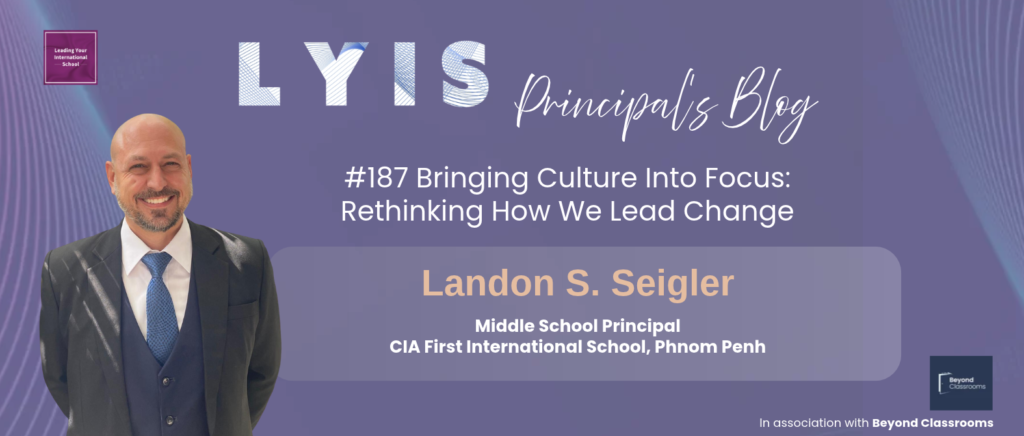
Landon S. Seigler, Middle School Principal, CIA First International School, Phnom Penh
LYIS is proud to partner with Beyond Classrooms





Leave a Reply